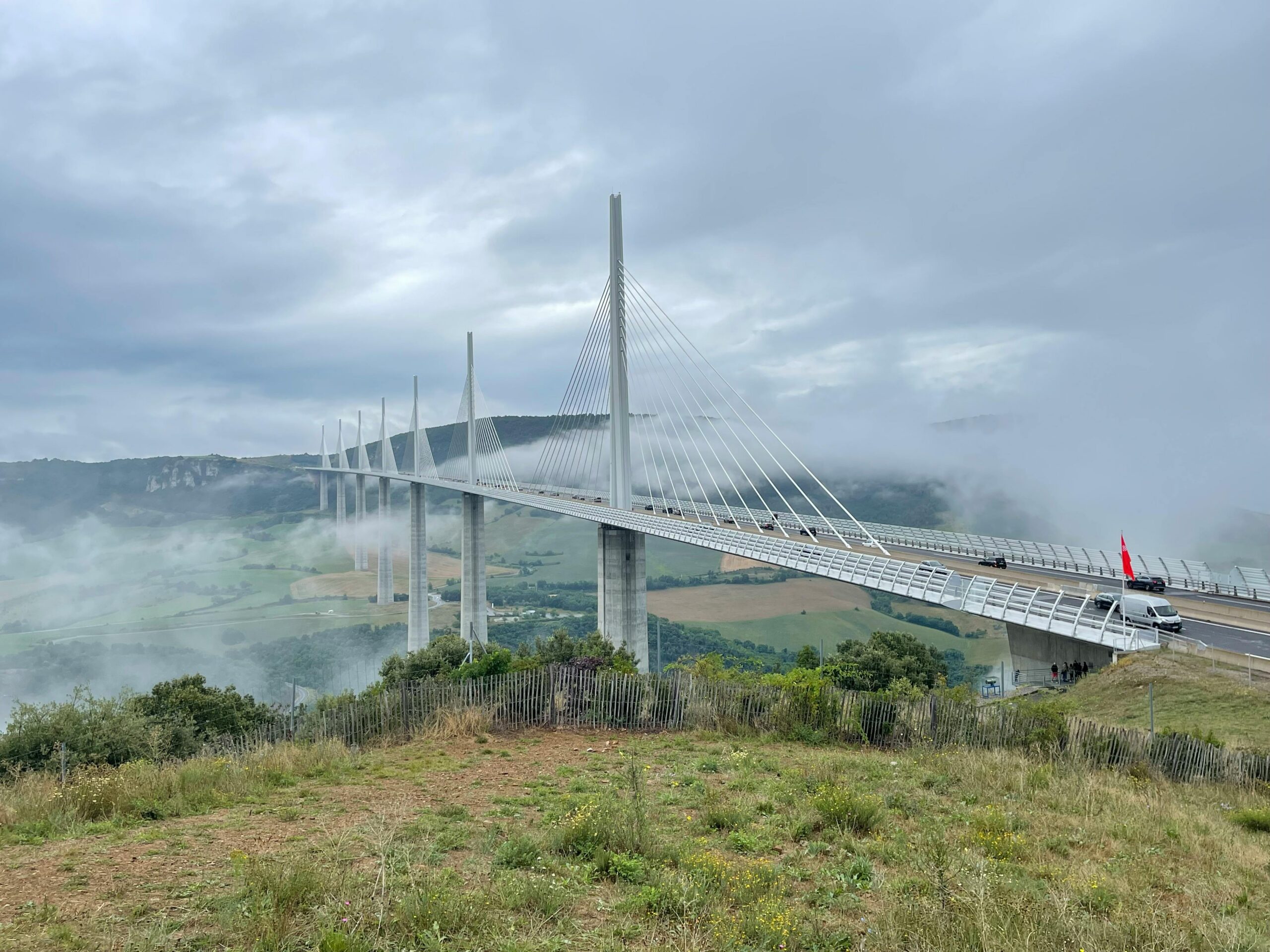
The Viaduc de Millau, located in southern France near the town of Millau in the Aveyron department, is one of the most remarkable engineering achievements of modern times. Spanning the Tarn Valley, this massive structure is not only a crucial part of the A75 motorway connecting Clermont-Ferrand with Béziers and the Mediterranean coast, but also a symbol of architectural elegance and technical innovation. The bridge was built to solve a long-standing problem. For many years, the town of Millau experienced severe traffic congestion, especially during holiday periods when travelers from across Europe made their way south. The A75 was conceived as a fast, toll-free motorway linking central France with the coast, but the deep Tarn Valley created a gap in the route that forced vehicles to descend into and climb out of the valley, causing long delays. A bridge was the only effective solution, and so the idea of the Viaduc de Millau was born. After an extended period of planning, environmental assessments, and public consultations, a design competition was held. The winning design was submitted by a British architect and a French structural engineer. Their vision was to create a cable-stayed bridge that would appear light, elegant, and respectful of the surrounding landscape, yet capable of withstanding the challenging conditions of the area, including strong winds and the geological complexity of the valley. Construction began in 2001 and lasted about three years. The bridge was inaugurated on December 14, 2004. At the time of its opening, and still today, it holds several records. The tallest of its seven concrete pylons, designated P2, reaches a height of 343 meters from the base to the top of its mast, making it the tallest bridge tower in the world—taller even than the Eiffel Tower. The bridge’s full length is 2.46 kilometers, and it carries a four-lane roadway that sits approximately 270 meters above the Tarn River at its highest point. Building the Viaduc de Millau was a significant technical challenge. To minimize disruption to the valley and its environment, many parts of the structure were prefabricated and assembled on site using advanced construction techniques. One of the most impressive aspects of the construction was the method by which the road deck was pushed out from each side, meeting precisely in the middle above the valley. This required meticulous planning and execution, with tolerances of only a few millimeters. Since its opening, the Viaduc de Millau has become much more than a piece of infrastructure. It has dramatically improved traffic flow along the A75, reduced pollution in the Millau valley, and attracted countless tourists who come just to see or drive across the bridge. Its graceful lines and soaring height have made it an icon of French engineering and a landmark of contemporary design. Today, the bridge remains a road for vehicles, but it is widely appreciated as worth the cost for the time saved and the experience of crossing one of the most impressive bridges in the world. There is also a nearby visitor center where people can learn about the history and construction of the viaduct and enjoy panoramic views of the structure and the surrounding countryside. The Viaduc de Millau stands as a testament to what can be achieved when design, engineering, and environmental respect come together. It is not only a functional link in the French transport network but also a modern architectural wonder admired around the world.