
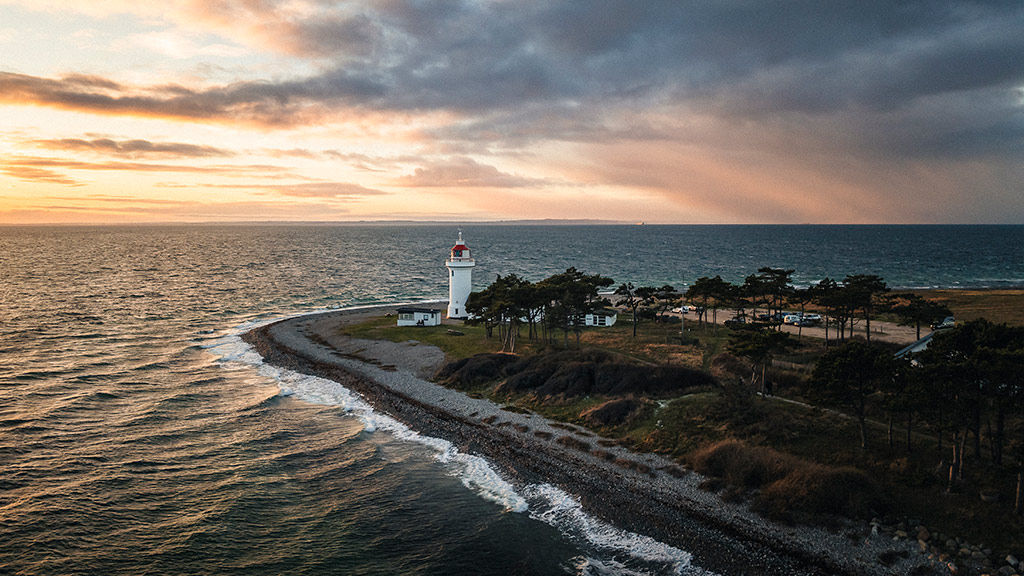

Sletterhage Fyr sits almost at the very end of the road, on the south-western tip of the Helgenæs peninsula, and it was one of those places where we were quite happy to stay for the whole day rather than simply stop, look at the lighthouse and move on. The setting is wonderfully open, with the pebble beach immediately beside the lighthouse and an uninterrupted view across the sea. On a clear day even the skyline of Aarhus can be picked out in the distance. What surprised us most was the amount of shipping: large vessels pass remarkably close to the coast here, so there was nearly always something moving across the view.
We arrived around midday and had no difficulty finding one of the five spaces reserved for motorhomes. It was quiet and peaceful during our visit, although the parking area itself is fairly simple: gravel, no shade and, in dry weather, a little dusty. That hardly mattered when the sea, lighthouse and passing ships were only a few metres away. The parking is free, although donations towards the association looking after the site are encouraged. Motorhomes are limited to 24 hours, a parking disc must be displayed, the five spaces are for vehicles up to 3.5 tonnes, and camping behaviour such as putting out tables, chairs or awnings is not allowed.
The lighthouse makes the place much more than simply a scenic motorhome stop. The first light at Sletterhage was established by Aarhus Municipality in 1872 to guide ships travelling to and from Aarhus, but the present lighthouse was built in 1894, about 300 metres farther west. The white concrete tower is 16 metres high, with the light itself at a height of 17 metres. Its position was carefully chosen because the water immediately offshore is unusually deep — around 40 to 50 metres — allowing even very large ships to pass surprisingly close to Helgenæs on their way to and from Aarhus Harbour.
Originally the flashes were produced mechanically. The lamp remained lit while shutters opened and closed around it, driven by a clockwork mechanism and a descending weight that had to be wound up every four hours. The lighthouse later became electric and was eventually automated in 1984, but it still operates as a navigational light. It is a sector light, displaying white, red or green according to the direction from which it is seen, helping vessels determine whether they are following the safe course.
The lighthouse can also be visited when it is open. Inside are small exhibitions dealing with the lighthouse, the sea and Helgenæs, and 53 steps lead towards the top. The site is largely maintained and opened by volunteers, which gives the place a rather different character from a conventional tourist attraction. There are public toilets and a room where visitors can sit and eat their own food, while the surrounding area remains accessible throughout the year.
Sletterhage also has a less peaceful chapter in its history. During the Second World War the southern tip of Helgenæs was strategically important to the German forces defending Aarhus and the southern Kattegat. Around 800 metres east of the lighthouse they built an observation position now known as Tyskertårnet, from where shipping could be watched by radar and visually and approaching Allied bombers could be detected. Today it can be reached as part of the walks through the surrounding coastal landscape.
For us, though, what made Sletterhage Fyr memorable was much simpler: the lighthouse almost on the beach, the wide view towards Aarhus, the constant procession of ships and the feeling of having reached the end of the peninsula. There are more spectacular lighthouses in Denmark, but relatively few places where the lighthouse, sea, passing maritime traffic and a peaceful place to stop all come together quite as naturally as they do here.